Nakashima-inspired furniture
“You don't design a piece of furniture and then look for the wood. You find the wood, and the furniture reveals itself within it.”
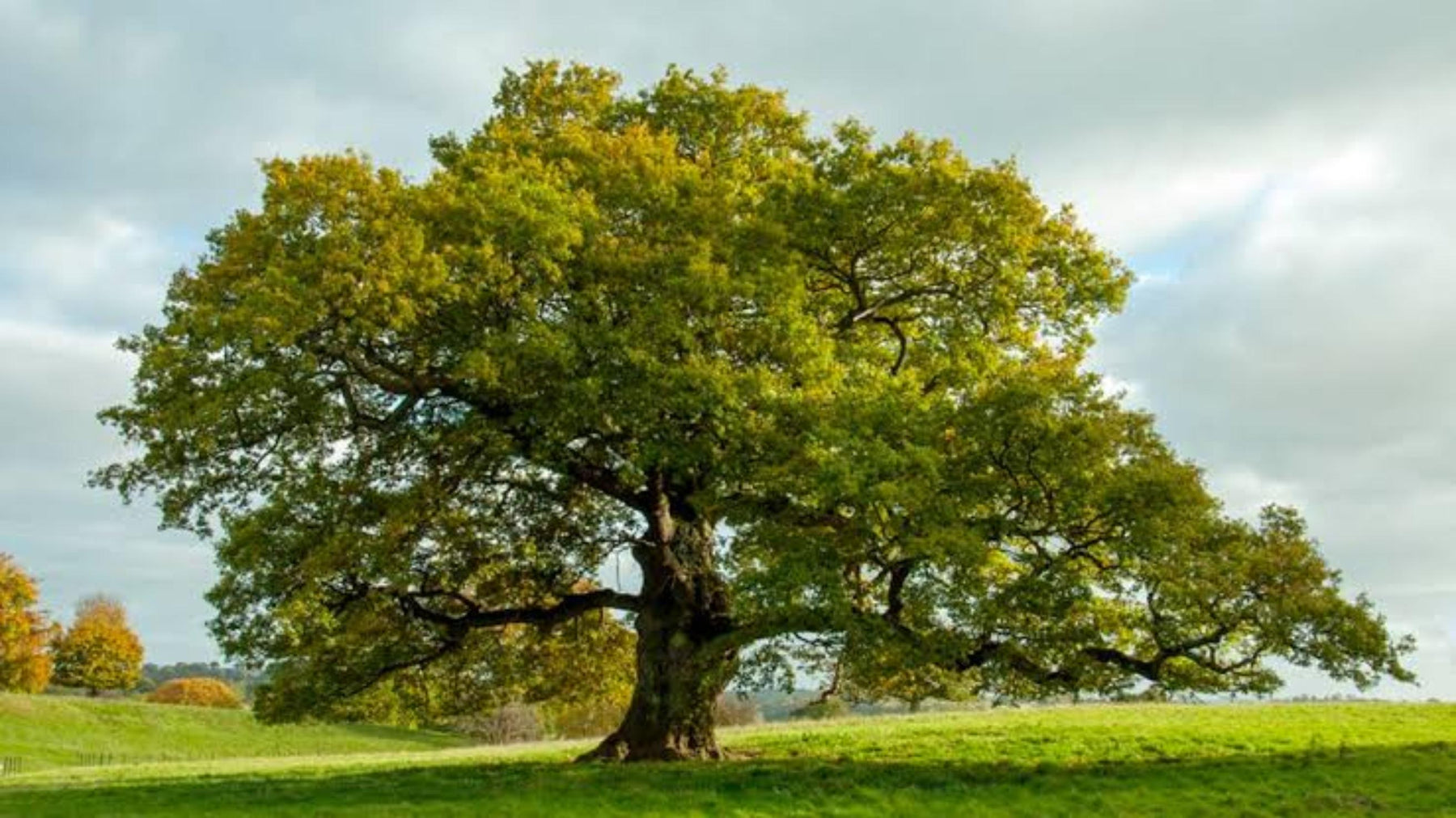
The tree first
George Nakashima (1905-1990), an architect by training who passed through Tokyo and Pondicherry, settled after the war in New Hope, Pennsylvania, where he founded one of the most significant workshops of the twentieth century. People remember his forms. What we remember above all is a method, and in our view it comes down to one sentence: he bought the tree.
Where industry orders standardised cubic metres sight unseen, Nakashima toured the sawmills to choose the logs himself, had them sawn according to his intuition, then left them to dry for years before knowing what they would become. The design came after the material — never the other way round. This is what he called giving the tree a second life.
This is exactly our practice. We buy the finest walnut logs the market has to offer, in advance, without yet knowing what piece of furniture will come from them. A remarkable walnut log cannot be ordered: you come across it, and you have to be there on that day. And have the means to buy it, then the patience and the time to let it dry, at a rate of 2 cm of thickness per year. This luxury is the only one a fine cabinetmaking workshop can afford, and one no factory can.
That is our true lineage with Nakashima. It is not so much a matter of style. It lies in the approach to the material.
What we do not take up
The natural edge — the live edge, that raw edge following the silhouette of the tree — has become the Nakashima signature. It is also, today, the most copied feature of contemporary woodworking. It is found everywhere, often where its only purpose is to announce from afar that the furniture is made of wood...
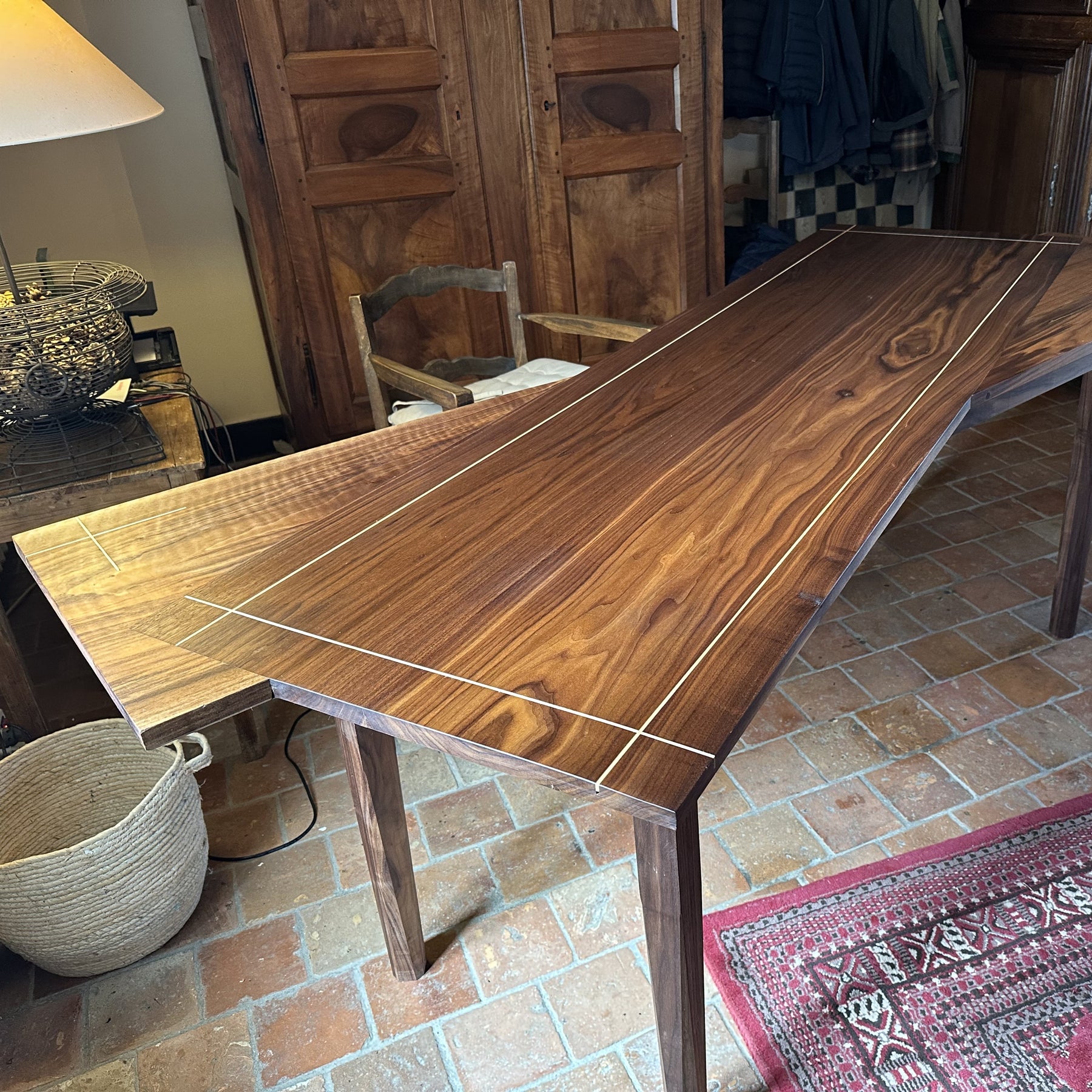
We do not use it. It is a choice, and a deliberate one: we prefer the straight line, less unsightly, purer, minimalist in fact. A top with drawn edges imposes a rigour that the natural edge spares you — nothing is left to distract the eye. The proportions must be right, the thickness exact, the grain of the wood beautiful and coherent enough to stand on its own. The live edge forgives a great deal. The straight line forgives nothing, or far less.
Nakashima modernised, then. Purer, more rectilinear. Our creations are deliberately timeless, neither classic nor contemporary, nourished as much by Japanese tradition as by the American school of woodworking — but they copy no one.
The butterfly, an admission of trust
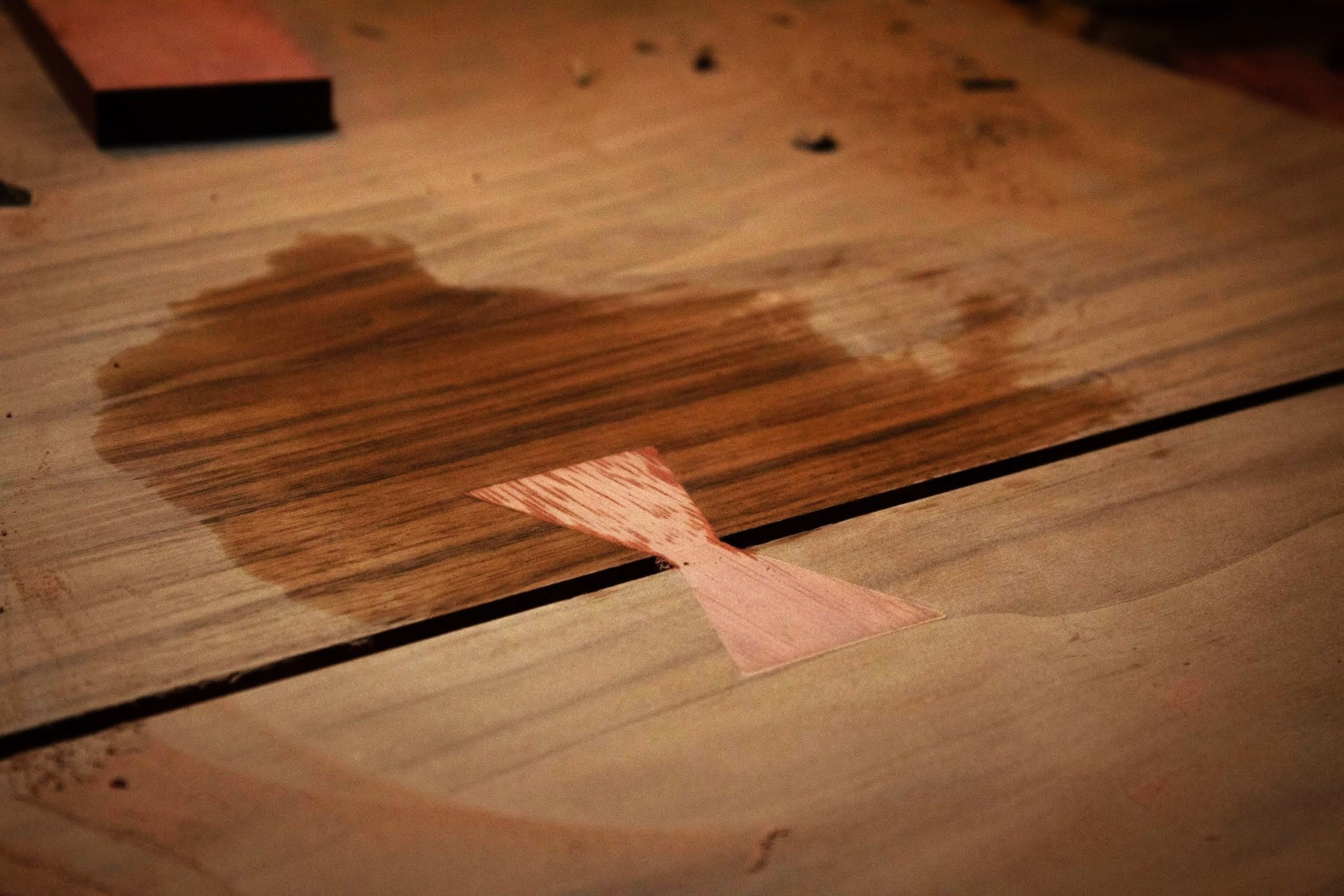
If we had to keep only one sign of Nakashima, it would be this one: the butterfly key. Which, incidentally, is not Nakashima's own: it was first used by Wharton Esherick, and taken up by G. Nakashima during his training with the master. This bow-tie-shaped piece, inlaid across a crack, stops the wood from splitting further, or allows two large slabs to be joined while limiting distortion. It is purely functional. It is also perfectly visible, and that is the whole point: the flaw is not hidden, it is acknowledged, treated, and the remedy becomes ornament.
It is a profoundly Japanese idea, a cousin of kintsugi, which highlights the break in a bowl with gold rather than concealing it. Wood is a material that lived before us and will keep moving after us. To pretend otherwise would be a lie.
We set these butterflies in walnut, rosewood, elm and other hardwoods into our walnut tops by hand, the mortise fitted with a chisel to a tenth of a millimetre. Our other joints meet the same standard: mortise and tenon, dovetails, pegs. No visible hardware, no screws (unlike most G. Nakashima originals). Finally, the finish consists of five successive coats of tung oil cut with orange solvent, with seventy-two hours' rest between each.
Three pieces, three debts
Where the influence shows, and where it stops.
Tsumugi (紬)
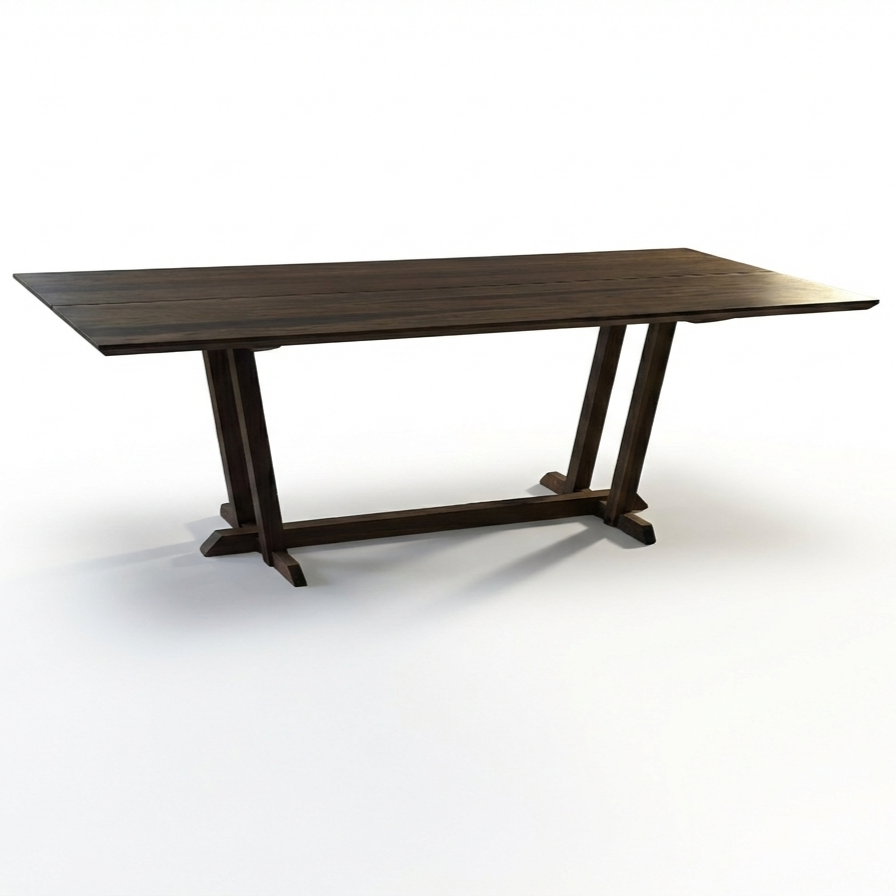
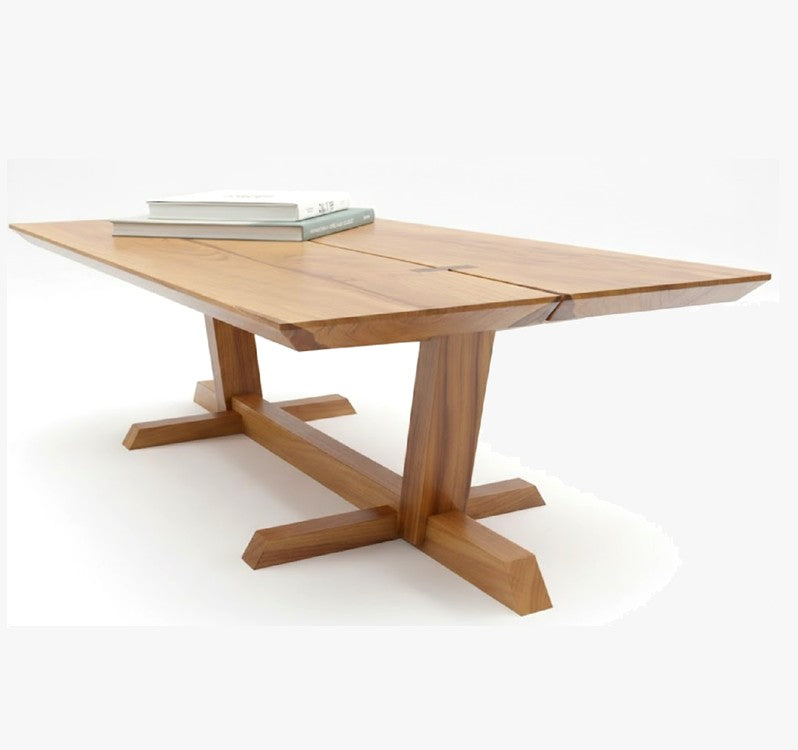
In Japan, the word refers to a silk woven from irregular threads — a fabric that became precious for that very irregularity. The name says what the table does: a large black walnut top where the figure is not set aside but placed at the centre. A reception table, drawn straight, elegant and airy, in contrast to the sacrosanct four legs, sometimes ungainly, or worse, to heavy central pedestals.
Henri
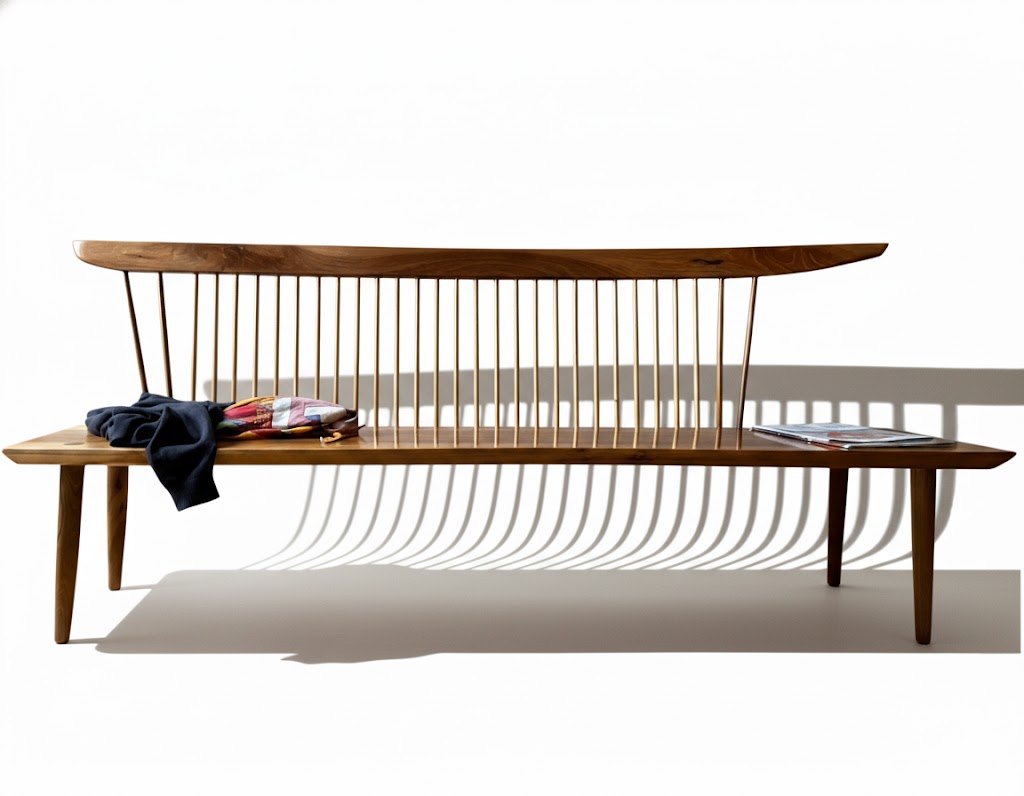
The bench is one of Nakashima's founding pieces. Henri takes up its sense of welcome and strips it back: a frank seat, an invitation to sit down. There is nothing to understand, only to sit. Aesthetically, it is the hardest piece to get right, because there is nowhere to hide.
Wharton
The name pays tribute to Wharton Esherick (1887-1970), sculptor and furniture maker based in Paoli, Pennsylvania, a few dozen kilometres from Nakashima's workshop. He came before him, and strongly influenced him. He is the true founder of the American studio furniture movement (the American studio craft movement), and yet he remains almost unknown in France — an injustice we never tire of righting with our visitors. This coffee table owes him the shape of its legs and its search for balance between sculpture and use. As much a sculpture as a piece of furniture.
A piece made for you
Our furniture consists of one-of-a-kind pieces, known as private productions, stamped, signed, numbered and accompanied by a certificate of origin. If you are looking for a piece in this spirit — a table, a bench, a desk in solid walnut — we design each project around the log available and your interior.